What is Blockchain?
It’s one of the most puzzling questions we find ourselves trying to answer when first discovering cryptocurrencies. Thus, getting blockchain explained is essential.
Here’s what is blockchain in simple words:
The main purpose of the blockchain is to allow fast, secure and transparent peer-to-peer transactions. It is a trusted, (usually) decentralized network that allows for the transfer of digital values such as currency and data.
Now, as we’re all newbies here. Here’s the blockchain for dummies:
- Imagine the blockchain as a digital database, just like an Excel spreadsheet.
- This database is typically shared across a large network containing many computers (known as “nodes”), and it is completely public. I say “typically”, because it can technically be formed by any number of nodes. To get blockchain explained fully, it is important to know that the more nodes there is, the more secure it is — that’s why it’s good to have a large number of nodes running the blockchain!
- Every time the network makes an update to the database, it is automatically updated and downloaded to every computer on the network.
- Blockchain technology is secured with cryptographic techniques, making it near impossible for hackers to make changes to it. The only way to make changes would be to hack more than half of the nodes in the blockchain, which again, is why it is more secure to have more nodes / computers running the blockchain.
That’s your blockchain explained in simple words. So, now when someone asks you “what is blockchain?”, you have two strong answers to choose from.
How Does Blockchain Work in the Case of Bitcoin?
Bitcoin was the first cryptocurrency to use blockchain technology. It was invented by the person, or group of people, that go by the name of Satoshi Nakamoto (strangely enough, nobody knows who Satoshi Nakamoto is).
The sole purpose of Bitcoin is to act as a store of value. It allows for peer-to-peer transactions that do not need a third party, such as PayPal or a bank.
Getting Bitcoin blockchain explained is essential to understanding how blockchain works. The Bitcoin blockchain is a database (known as a “ledger”) that consists only of Bitcoin transaction records. There is no central location that holds the database, instead, it is shared across a huge network of computers. So, for new transactions to be added to the database, the nodes must agree that the transaction is real and valid.
This group agreement is also known as a “consensus”. It occurs during the process of mining.
Once the nodes agree that the transaction is real, it is then added to a “block” (which is why it is called a blockchain) and is placed below the previous block of transactions in the ledger.
For a transaction to be valid, the computers on the network must confirm that:
(1) The account holds the amount of Bitcoin that the user wants to send.
(2) The amount hasn’t already been sent to someone else.
For example, let’s imagine that Tom tries to send $10 of Bitcoin to Ben. Tom only has $5 worth of Bitcoin in his wallet. Because Tom doesn’t have the funds to send $10 to Ben, this transaction would not be valid. The transaction will not be added to the ledger.

This means that nobody can ever spend the same money twice! This can often be a big problem for standard banks and payment systems.
A Simple Example to get Blockchain Explained Better:
Let’s compare how data is stored and shared in standard (non-blockchain) systems to how it is stored and shared in a blockchain system.
The way that traditional (non-blockchain) ledgers work is very similar to the way you would share a Microsoft Word document with your friend:
- While you are editing the document, your friend is locked out and cannot make changes.
- Once you have finished making your changes, you send it to your friend to edit it further.
- Now while your friend is editing the document, you are locked out and cannot make changes until they are finished and send it back to you.
In a blockchain system, however, all users can view the changes while they are being made.

The data is accessible in a secure and shared environment, instead of being locked to one company or person at a time (at the risk of losing the data). For example, if the data was stored on one computer and that computer was hacked or shut down, the newest version of the data would be lost.
Now, to get blockchain explained: with the blockchain, the data is stored on all the computers / nodes that run it. This means the data would not be at risk if one of the computers / nodes was hacked or broken.
As you can see, blockchain technology does not just benefit cryptocurrencies. It benefits many different industries. Imagine the amounts of legal, health, accounts and customer data, etc. that should be used this way.
This is just one of the many advantages of blockchain technology! Now, let’s look at some of the others.
Key Advantages
 | Simplifying Business Most businesses use different systems, so it is hard for them to share a database with another business. |
 | Trust & Transparency Trust is an essential part of getting the difficult world of blockchain explained. |
 | Cost-Effective As the blockchain is a trusted peer-to-peer network, it removes the need for a central third party. |
 | Unbreakable Once a transaction is confirmed, it is stored on the ledger and protected using cryptography. |
 | Availability Blockchain is a decentralized peer-to-peer network, and there is no central point of failure. |
 | Decentralized Decentralization is one of the core — and most important — advantages of blockchain technology. |
Decentralized
Decentralization is one of the core — and most important — advantages of blockchain technology. It has been a highly-desired concept for many years, but it was blockchain technology that made it possible.
To get the blockchain explained in simple words, it requires no central server to store blockchain data, which means it is not centralized. This is what makes the blockchain so powerful.
Instead of the server being stored in one place, it is stored on the blockchain, and is powered by many different computers / nodes. This means there is no third party to trust and pay a fee to.
Unbreakable
Once a transaction is confirmed, it is stored on the ledger and protected using cryptography. It cannot be changed or deleted without a consensus (the group agreement), which makes the blockchain unbreakable. Pretty cool, eh?

Trust and Transparency
Trust is an essential part of getting the difficult world of blockchain explained. As it is a shared database, everyone can view the full details of the transactions within it. These include the source, date, time and destination of the transaction.
Cost-Effective
As the blockchain is a trusted peer-to-peer network, it removes the need for a central third party. This is one of the major benefits for businesses as it completely removes the costs that are required to pay third parties.
Faster Operations
Let’s use a real-world example:
Imagine that you want to send a payment to someone in another country. Without the help of blockchain technology, you would normally need to pay expensive fees (to the banks), and the transaction may take 3-10 days to be processed.
Using blockchain, this can be done almost instantly and at a much cheaper cost.
Availability
Blockchain is a decentralized peer-to-peer network, and there is no central point of failure. Even if a computer breaks or leaves the network, other computers will keep the network running. That's why this is a huge, huge advantage.
To get the blockchain explained even clearer, just imagine a hospital server: it contains important data that needs to be accessed at all times. If the computer holding the latest version of the data was to break, the data would not be accessible. It would be very bad if this happened during an emergency!

If the hospital used a blockchain, however, it wouldn't matter if a computer broke. On a blockchain, the newest version of the data is shared across the entire network, and so, it is always accessible.
Simplifying Business to Business
Most businesses use different systems, so it is hard for them to share a database with another business. That's why it can make it very difficult for them. So, the answer is blockchain technology!
As a blockchain can act as a single shared database for both businesses to work from, sharing data is much easier for them on a blockchain system.
Blockchain in Real-World Industries
To help you understand some of the other advantages that blockchain offers to businesses, here are some examples of industries that are currently using blockchain technology. This will surely get blockchain explained!
Identity
Cybersecurity threats are a huge problem in the identity management industry. In the current world, our identity is controlled by large companies. Whether that be Netflix, Facebook, Instagram, or even the companies we work for.
People are always under the threat of having their identities stolen by cyber-thieves — also known as hackers. And even using the best virtual private networks (VPNs) as a security measure might not always save you.
All of these companies use centralized servers. For example, Netflix is the central point of the Netflix server — if Netflix is hacked, all the data they hold for their customers is at risk.
It was only recently that Equifax’s data was hacked.
INTERESTING FACT
Equifax is one of the largest credit reporting agencies that hold the personal information of over 800 million customers. This caused the data of over 145 million users to be stolen.
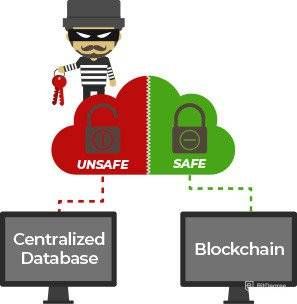
So, how can personal data hacking be stopped using the blockchain?
Well, your data is currently held in a centralized database (just like at Equifax). A centralized database is much easier to hack into because it uses one main server. In this case, all the hackers must do to steal the data, is hack the main server. In a blockchain, there is no main server — there is no central point for a hacker to attack! Here's a great advantage of blockchain explained.
Energy Supply
In the past, people had only one option to receive energy — through a centralized source.
However, we are now able to gather renewable energy from our own devices, or from new grid systems called “microgrids”. Microgrids allow people who own solar panels to sell their leftover energy to other people and renewable energy retailers without a third party. So, let's get another advantage of blockchain explained.
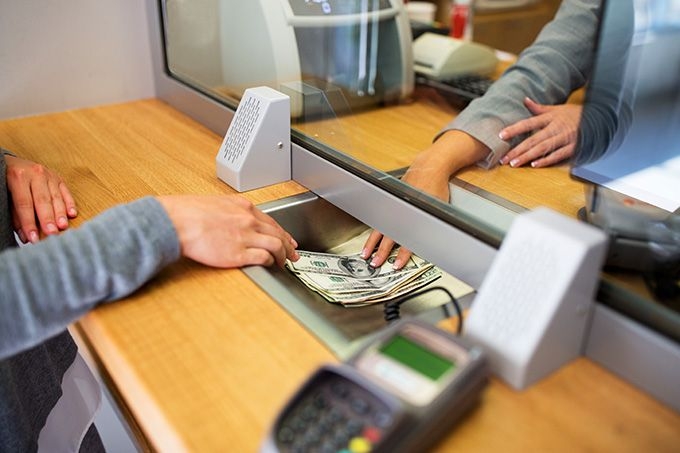
Before blockchain technology, people could only sell their leftover energy to retailers (the third party). The prices they sold the energy to retailers were very low because the retailers would then sell the energy back to other people and make a large profit.
As blockchain technology removes the third party, people can agree on a price that is fair for them both — cutting out the cost that was previously taken by the retailers.
Blockchain will change the way that many more industries currently operate
The examples above are only a small part of what is possible using the blockchain. Blockchain is being applied to many more industries than the ones listed above.
Here are some of the other industries that are currently using blockchain to improve the way they operate:
- Cybersecurity
- Education (like BitDegree!)
- Marketing & advertising
- Supply-chain management
- Government systems
- Music & video sharing
- E-commerce
- Voting
Comments
Post a Comment